

Choosing an AI tool is not only about which provider to use. It is also about which workspace fits the job. This workshop teaches a three-part model: chat, work, and code. Actual product names differ, so treat the model as a practical guide rather than a promise about every screen.
Chat: one conversation
Choose Chat for a one-off conversation: a question, an idea, a short draft, or a quick explanation. In the OpenAI route, that is ChatGPT. In the Anthropic route, that is Claude.
Work: hand off a deliverable
Choose Work when you want to delegate a multi-step deliverable and return to work ready for review. In the OpenAI route, this is ChatGPT Work. In the Anthropic route, this is Claude Cowork.
Work and Cowork are sibling surfaces, not merely code with extra guardrails. They fit a different task shape: give the agent an outcome, steer it as needed, and review the deliverable.
Code: build a reusable working system
Choose Codex or Claude Code when you need a controlled, reusable working system rather than one deliverable. This workshop uses that route when the task needs persistent directives, reusable skills, project files, tools, validation, and repeatable workflows.
Codex and Claude Code may look coding-specific because of their names and interfaces. The word code does not mean that everyone in the workshop must become a software developer. The same controlled project approach can support office work, including an email draft, a report, research organisation, a document workflow, or another task that benefits from consistent files, instructions, checks, and repeatable steps.
External tools and integrations can extend the capability of a working system when they are deliberately enabled. They are not automatically available or automatically appropriate. For this workshop, Codex or Claude Code is the recommended maximum-capability route, while the right choice still depends on the task, your permissions, and the risk involved.
Directives, memory, and continuity
ChatGPT and Claude chat have their own personalisation or instruction mechanisms. They are useful for shaping a conversation. Codex and Claude Code also use documented file-based project directives. For this workshop, those directives give the strongest practical control for reusable office workflows because they can stay with the project alongside its files and working practices.
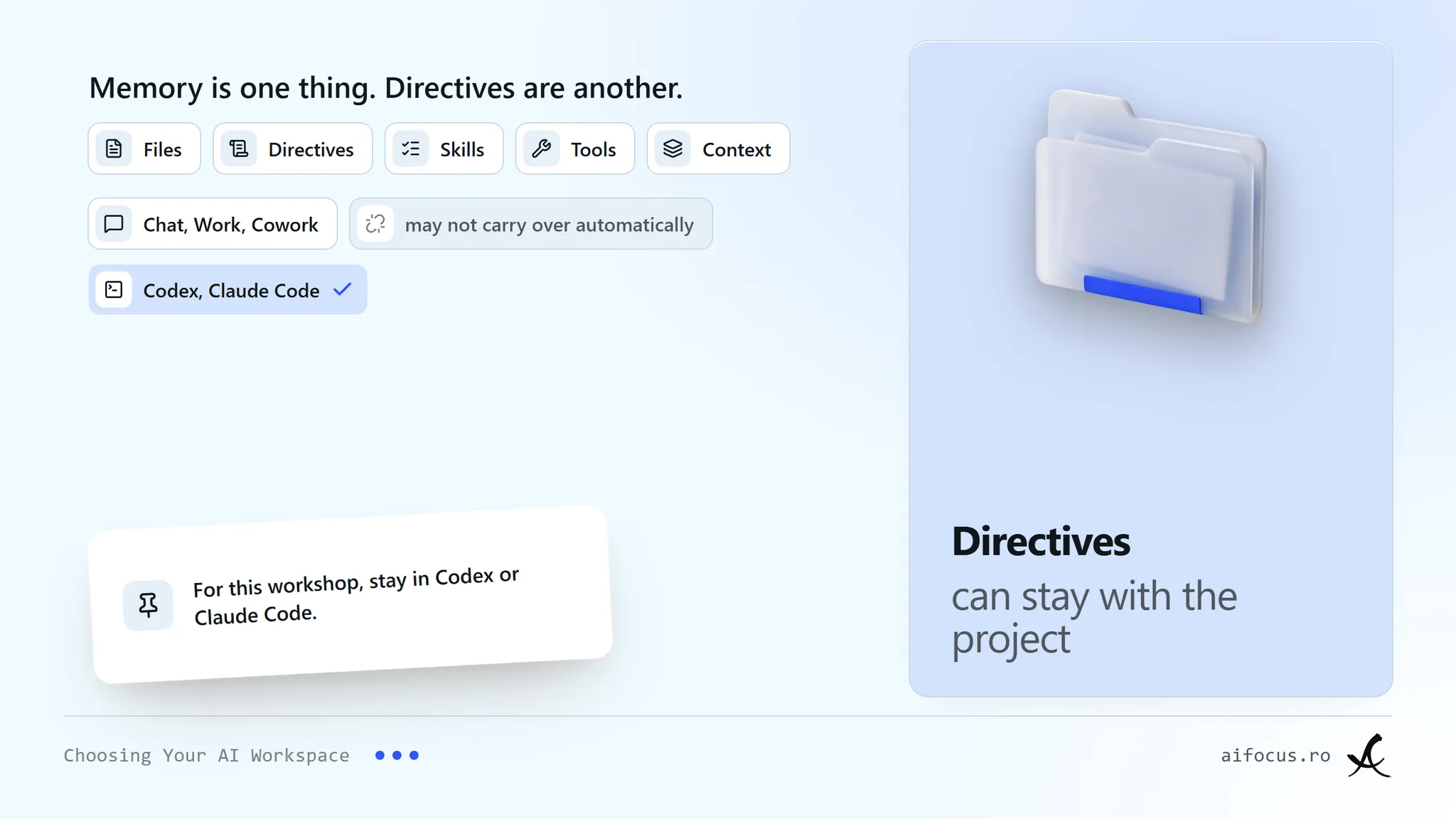
Keep memory and directives separate in your thinking. Do not assume that memory saved in ChatGPT Work or Claude Cowork is also available in Codex or Claude Code. For other instructions, do not assume they carry over automatically between those related surfaces. For this workshop, stay in Codex or Claude Code.
When directives, skills, tools, and project context matter, use Codex or Claude Code as your primary workspace. Do simpler conversational tasks there too when practical. Moving to Chat, Work, or Cowork may not carry the same setup or context automatically. Staying in one chosen code-capable workspace reduces context switching and configuration drift, while each fresh session still loads context according to its actual scope.
The selection rule
- ChatGPT or Claude: one-off conversation.
- ChatGPT Work or Claude Cowork: delegated multi-step deliverable.
- Codex or Claude Code: controlled, reusable project work with directives, skills, files, tools, validation, and workflows.
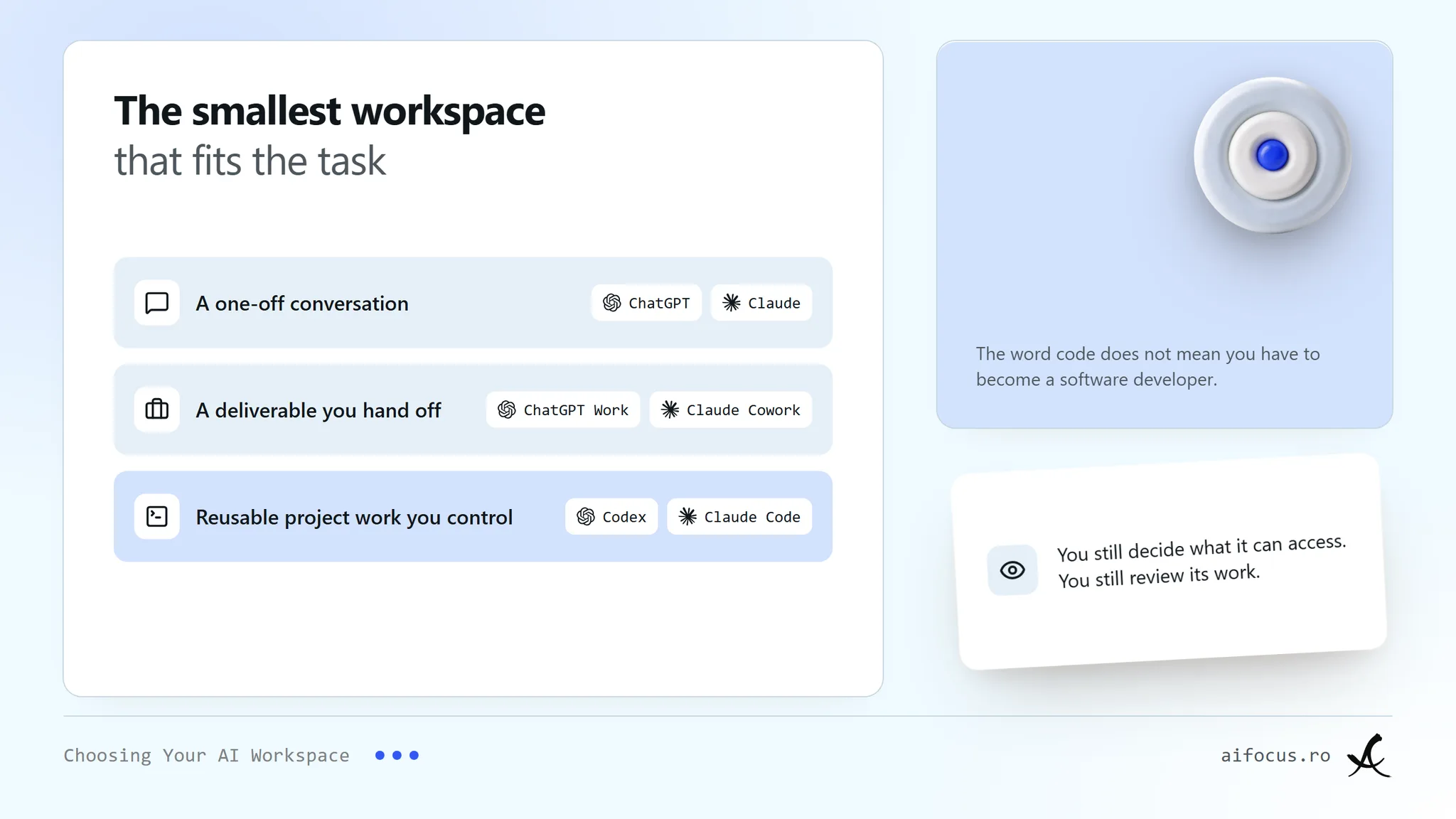
Use the smallest surface that fits the task. When you need the code-capable route, you still decide what it may access and review its work. Choose a primary workspace deliberately, then keep the files, directives, skills, tools, and context practices that make your work dependable together there.
Product sources checked: 12 September 2026. ChatGPT Work is described on OpenAI's ChatGPT Work announcement; Claude Cowork is described on Anthropic's Claude Cowork product page. Confirm current names and behaviour before relying on this comparison.